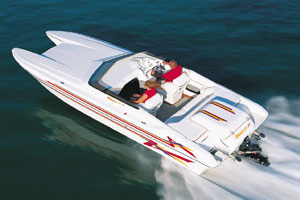
Profile 28' Cat: Performance Test
Profile's 28' Cat: You don't have to be a professional driver to have a blast.
January 15, 2003

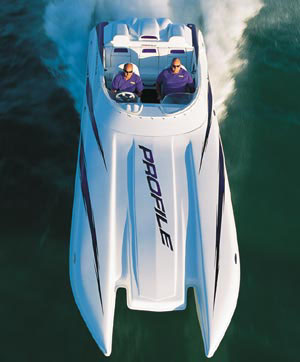
Top speed for the 28' Cat was 92.5 mph at 5,000 rpm. (Photo by Tom Newby)
You can argue to death about the superiority of catamarans over V-bottoms or vice versa. But both boat species have members that are tough to drive. There are many cats and V-bottoms that can make anyone other than an expert driver look—and feel—green.
That was the last thing Randy Schultz, owner of Profile Boats in Sumner, Iowa, wanted when he designed his 28' Cat. According to Schultz, driveability topped his priority list when he created the 28'-long, 8'6"-wide model.
That's a worthy goal, and Schultz achieved it, at least in the 28' Cat we tested in Placida, Fla. Equally worth pursuing is reliability, and to that end, the boat was outfitted with a warranted Mercury Racing HP575SCi engine. Equipped with that mill and other options, the cat cost $123,773, about $17,000 more than the base offering with a Mercury Racing HP500EFI motor.
Performance
Each of the 28' Cat's two sponsons had an 18-degree transom deadrise, two steps and a full-length inline strake. Chines were flat and about 2 inches wide. The boat also had a center pod in its relatively shallow tunnel.
Handling the juice from the 550-hp fuel-injected, supercharged mill was a Bravo One XR drive with 1.5:1 reduction. At the business end of the drive was a lab-finished Bravo One 15 1/4" x 32" four-blade stainless-steel propeller.
Top speed for the 28' Cat was 92.5 mph at 5,000 rpm, but it was how the boat behaved at that speed, how connected to the water and predictable it felt, that most impressed our lead test driver.
"We tested one of these models at our Ventura (Calif.) Trials a few years back, and it wasn't that refined," he said. "Now we have one that's really refined—quite a ways from where it was—and it's a nice, comfortable boat at speed. It's definitely faster into the wind, and it could definitely tolerate more power."
Time to plane was 4.9 seconds, and the cat reached 70 mph in 20 seconds. Given the power involved, those numbers were respectable, as were the boat's midrange acceleration times of 5.4 seconds (30 to 50 mph) and 6.2 seconds (40 to 60 mph).
Part of what made the 28-footer so comfortable to drive at speed was its consistent tracking. The cat also handled low-speed slalom turns exceptionally, as it did at 50 mph. In slalom turns at 40 mph, the boat tended to roll to the outside and lift the inside sponson. Wide,
"It turns well," said our test driver. "Of course, it's a cat, and you don't just want to crank over the wheel at high speed."
Workmanship
Taking the less-is-more route with the 28' Cat's graphics, Profile dressed the boat in white gelcoat with painted red stripes and black fades. Gelcoat shine was ample, and though there were a few waves in the mold work, none of it was major. Installation of the boat's plastic rubrail with a rubber insert showed ample attention to detail.
Profile hand-laid the 28' Cat with a 1-ounce skin coat and 3-ounce backing. A barrier coat backed the gelcoat. Strakes were putty-filled and backed with 1 1/2-ounce bedding and balsa. The boat's hull and deck were fiberglassed together, as well as bonded with Plexus.
Checking out the catamaran's hardware, we found a cat-eye-nav light and an Accon Pull-Up? cleat up front on each sponson. On the inner side of the starboard sponson was a stereo remote control—not a bad gizmo to have when beaching the cat is the call. Two more of those Accon cleats were amidships beside the fairings, which attached to the deck with an adhesive sealant, and two more were all the way aft. A billet grab handle/bilge vent was mounted on the transom above each of the two billet swim platforms.
To secure the motor under the power engine hatch, the builder used Mercury's single-engine offshore plate on L-angles that were through-bolted to the stringers. Profile also did an exceptionally tidy rigging job when it came to wiring and hosing. Both were protected in conduit and supported—in parallel runs—with stainless-steel cushion clamps. Under-dash wiring, which we later inspected, also was neat and secure.
Interior
We're not sure why, but the cockpit of the 28' Cat felt more spacious than it really was. That's likely because the manufacturer didn't try to overstuff the model—it is, after all, a day boat with no cabin.
Seating arrangements in the carpeted cockpit consisted of two high-back bucket seats and a rear bench. In a smart move, the builder hinged the bottom cushions for the bench and used the molded area below them to create three separate draining coolers. For smaller items that don't need to be kept cold, the gunwale trays should do nicely.
The port-side co-pilot's station featured a Clarion CD stereo, a 12-volt power outlet and a grab handle. Like the helm station, the co-pilot's position also had an angled footrest.
Spread across the entire dash, the Gaffrig gauges—including a 120-mph GPS speedometer—were mounted in bezels angled toward the driver. On the dash above and to the left of the tilt steering wheel were switches for the accessories. Gaffrig mechanical drive-trim indicators were located to the right of the wheel. The Kiekhaefer throttle and shifter was mounted in a fiberglass housing next to the gunwale.
Overall
Profile's 28' Cat is well built and reasonably priced. Plus, it's easy to drive. Of course, as with any fast boat, new owners need to get to know it before they air it out. But at least that won't take a lifetime.
Hull and Propulsion Information
| Deadrise at transom | 18 degrees |
| Centerline | 28' |
| Beam | 8'6" |
| Hull weight | 4,800 pounds |
| Engine | Mercury Racing HP575SCi |
| Cylinder type | V-8 |
| Cubic-inch displacement/horsepower | 502/550 |
| Lower-unit gear ratio | 1.5:1 |
| Propeller | Mercury Bravo One lab-finished 15 1/4" x 32" |
Pricing
| Base retail | $106,900 |
| Price as tested | $123,773 |
Standard equipment
Mercury Racing HP500EFI engine, IMCO external drive shower, IMCO exterior hydraulic steering, Mercury Bravo One stainless-steel prop, race-mounted motor, IMCO high-performance fuel valve, Gaffrig instruments, GPS speedo, Kiekhaefer controls, tilt steering, power masthead light, power engine hatch, pop-up cleats, half canopies, cockpit cooler, trim switch on controls, fire extinguisher and Clarion CD stereo.
Options on Test Boat
Upgrade to Mercury Racing HP575SCi engine ($14,500), full hydraulic dual-ram steering ($1,850) and Halon fire system ($523).
Test Results
Acceleration
| 5 seconds | 24 mph |
| 10 seconds | 44 mph |
| 15 seconds | 58 mph |
| 20 seconds | 70 mph |
Midrange Acceleration
| 30-50 mph | 5.4 seconds |
| 40-60 mph | 6.2 seconds |
| 40-70 mph | 11.5 seconds |
Rpm vs. Mph
| 1000 | 8 mph |
| 1500 | 8 mph |
| 2000 | 27 mph |
| 2500 | 38 mph |
| 3000 | 50 mph |
| 3500 | 63 mph |
| 4000 | 72 mph |
| 4500 | 85 mph |
Top Speed
| Radar | 92.5 mph at 5,000 rpm |
| Speedometer | 91 mph at 5,000 rpm |
| Nordskog Performance Products GPS | 90 mph at 5,000 rpm |
Planing
| Time to plane | 4.9 seconds |
| Minimum planing speed | 19 mph |
Fuel Economy
| At 35 mph | 2.2 mpg |
| At 45 mph | 1.7 mpg |
| At 55 mph | 1.8 mpg |
| At 65 mph | 1.9 mpg |
| At WOT | 1.9 mpg |
| Fuel capacity | 120 gallons |
For More Information
Profile Custom Boats
Dept. PB
1308 W. First St.
Sumner, IA 50674
(319) 578-8556
www.profilecustom.com.